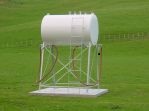
On-farm fuel storage plans needed by Nov. 10
The U.S. Environmental Protection Agency (EPA) has finalized its Spill Prevention, Control and Countermeasures (SPCC) rule that governs oil and fuel storage for many businesses, including farms.
The SPCC rule pertains to farms that have above-ground oil storage with an aggregate capacity greater than 1,320 gallons or completely buried storage capacity of more than 42,000 gallons. Residential home oil containers and oil tanks smaller than 55 gallons are exempt. EPA modified earlier versions of the proposed rules, and in some respects, attempted to address concerns raised by IFB, American Farm Bureau Federation, and other agricultural groups.
The rules require farms that meet a certain storage threshold to prepare and implement a plan and have a secondary containment structure around their tanks. Under the rules, there are different compliance requirements based on a facility's storage capacity. For smaller-capacity facilities with an aggregate storage capacity of 10,000 or fewer gallons, EPA has two categories.
To qualify, the smaller facilities must not have had a single discharge of more than 1,000 gallons into navigable waters within the three years prior to the date the SPCC is certified. The farm also cannot have had two oil discharges of more than 42 gallons into navigable water within a 12-month period.
In addition to meeting the spill history requirement, smaller-capacity facilities must have 10,000 or fewer gallons of aggregate storage and cannot have any single above-ground storage container with capacity of more than 5,000 gallons. Facilities that meet the smaller-capacity category may use an EPA plan template and self-certify their plan. They do not have to have a plan certified by professional engineer.
Facilities that have 10,000 or fewer gallons of aggregate storage and a single tank of more than 5,000 gallons would fall into a second-tier category. They also may self-certify a plan, but it would not be an EPA template plan.
Facilities with more 10,000-gallon storage capacity must have a plan approved by a professional engineer.
Additional information is available online at:
General SPCC information:
{http://www.epa.gov/emergencies/content/spcc/index.htm} and
SPCC plan template for smaller-capacity facilities {http://www.epa.gov/emergencies/content/spcc/tier1temp.htm}.
|
If… |
Then: |
| If a farmer has an aggregate capacity of more than 1,320 gallons aboveground oil storage or more than 42,000 gallons completely buried oil storage capacity… | Then a farmer would have to comply with the SPCC Rules by developing an SPCC Plan, having containment under the tanks (or having double walled tanks), establishing monitoring, and following other aspects of the Plan. |
| If a farmer has an aggregate aboveground oil storage capacity of 10,000 gallons or less... | Then a farmer can self certify an SPCC Plan. |
| If a farmer does not have an individual container that has a storage capacity of more than 5,000 gallons and has an aggregate storage on the farm of 10,000 gallons or less… | Then a farmer may use the Environmental Protection Agency (EPA) SPCC template when developing a Plan. |
| If a farmer has any individual container that has a storage capacity of more than 5,000 gallons, and has an aggregate storage on the farm of 10,000 gallons or less… | Then a farmer may still self-certify a plan but may not use the EPA SPCC template when developing a Plan. |
| If a farmer has an aggregate aboveground oil storage capacity of more than 10,000 gallons… | Then a farmer would have to use a Professional Engineer to develop an SPCC Plan. |
| If a farmer has oil storage but the storage sites are on different farm parcels… | Then a farmer would not have to add all of the different sites together to calculate whether the 1,320 aggregate storage capacity threshold is exceeded, thereby requiring compliance with the SPCC rules. |
| If a farmer has double-walled tanks… | Then that meets the containment requirement of the SPCC rules. |